Seismic engineering in Albuquerque encompasses a comprehensive suite of analytical and design services aimed at mitigating earthquake risk for buildings, infrastructure, and critical facilities. While New Mexico is not as seismically active as California, the Rio Grande Rift—a major continental rift zone—runs directly through the region, generating moderate but real seismic hazards. This category addresses the full lifecycle of seismic resilience, from subsurface investigation to structural isolation, ensuring that projects meet both life-safety and performance objectives in a geologically unique setting.
Albuquerque's seismic profile is shaped by Quaternary faulting along the rift margin, deep alluvial basin deposits, and variable groundwater conditions. The western portion of the city sits atop the Llano de Albuquerque, a thick sequence of unconsolidated sands and gravels, while areas nearer the Sandia Mountains encounter shallower bedrock and more complex stratigraphy. These contrasts directly influence how seismic waves propagate and amplify, making site-specific analysis essential. An site response analysis quantifies how local soil columns modify bedrock motion, revealing potential resonance effects that standard code spectra may not capture.
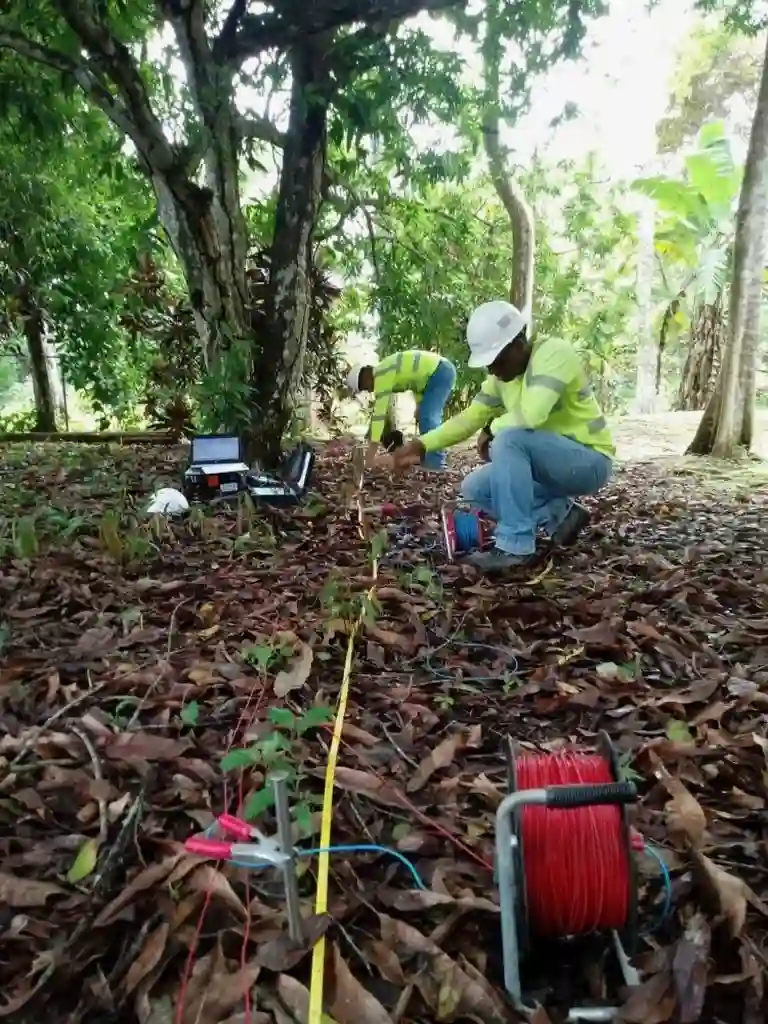
Because basin-edge effects and liquefiable lenses can occur in the Rio Grande floodplain deposits, a thorough soil liquefaction analysis is often the first step in determining a site’s vulnerability. Loose, saturated sands and silts in areas such as the North Valley or near the river corridor may experience significant strength loss during prolonged shaking, threatening foundation stability. These evaluations follow guidelines from the American Society of Civil Engineers (ASCE 7) and the International Building Code (IBC), which New Mexico adopts with state-specific amendments. The New Mexico Commercial Building Code (NMCBC) incorporates these national standards, requiring seismic design for most structures in Seismic Design Category B or higher, which covers much of the Albuquerque metropolitan area.
Projects that demand this category of services range from high-rise towers in the downtown Innovation District to essential facilities like hospitals, data centers, and emergency operations hubs. Transportation infrastructure—including bridges, overpasses, and light rail extensions—also relies on advanced seismic evaluation to ensure post-earthquake functionality. For structures housing sensitive equipment or high occupant loads, base isolation seismic design offers a performance-based solution that decouples the superstructure from ground motion, dramatically reducing drift and acceleration. This approach is increasingly specified for new municipal buildings and retrofits of unreinforced masonry structures, which are common in older Albuquerque neighborhoods like Barelas and Old Town.
Quick answers
How seismically active is Albuquerque compared to other U.S. cities?
Albuquerque experiences moderate seismicity due to the Rio Grande Rift, a zone of crustal extension that generates infrequent but potentially damaging earthquakes. While the hazard is lower than in California or the Pacific Northwest, the city's location on deep basin sediments can amplify ground motion, making site-specific seismic evaluation critical for safety and code compliance.
When is a site-specific seismic analysis required instead of using standard code values?
A site-specific analysis is typically required when a project is classified as Seismic Design Category C or higher under ASCE 7, or when deep soft soils, basin-edge effects, or liquefaction potential are present. The IBC and NMCBC mandate such studies for essential facilities and structures where standard spectral ordinates may underestimate actual ground motion.
What role does local geology play in Albuquerque's seismic risk?
The Rio Grande Rift basin contains hundreds of meters of unconsolidated alluvial deposits that can trap and amplify seismic waves, especially at longer periods. This basin amplification, combined with shallow groundwater in river-adjacent areas, increases both shaking intensity and liquefaction susceptibility, directly influencing foundation design and structural detailing.
Is seismic design mandatory for all new construction in Albuquerque?
Yes, all new construction must comply with the seismic provisions of the NMCBC, which adopts IBC standards. Most of Albuquerque falls within Seismic Design Category B or C, requiring engineered lateral systems. Certain structures, like hospitals and emergency facilities, face stricter requirements regardless of mapped hazard, necessitating advanced analysis and possibly base isolation.